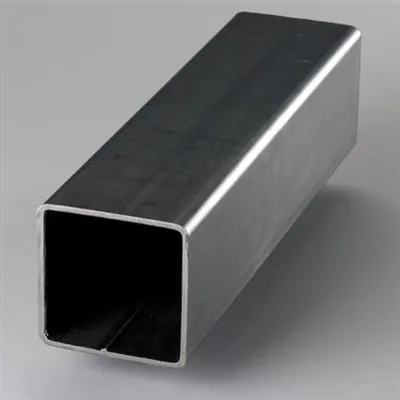
When it comes to construction and engineering projects, the load - bearing capacity of materials is of utmost importance. As a supplier of hollow square steel tubes, I often get asked about the load - bearing capacity of these tubes. In this blog, I will delve into what the load - bearing capacity of a hollow square steel tube is, the factors that influence it, and how it can be calculated.
Understanding Hollow Square Steel Tubes
Hollow square steel tubes are a popular choice in various industries due to their versatility, strength, and cost - effectiveness. They are used in construction for building frames, support structures, and in manufacturing for machinery and equipment. The hollow design provides a good balance between strength and weight, making them an efficient option for many applications.
There are different types of hollow square steel tubes available in the market. For example, the mild steel square hollow section is a common choice. Mild steel is known for its good ductility and weldability, making it suitable for a wide range of applications. Another type is the Rectangular Steel Tubing, which has a rectangular cross - section and can be used in applications where different dimensions are required. The Hot Rolled Square Tube is produced through a hot - rolling process, which gives it certain mechanical properties.
Factors Affecting the Load - Bearing Capacity
The load - bearing capacity of a hollow square steel tube is influenced by several factors:
1. Material Properties
The type of steel used in the tube plays a significant role. Different grades of steel have different yield strengths and ultimate tensile strengths. For example, high - strength steel will have a higher load - bearing capacity compared to mild steel. The chemical composition of the steel, such as the amount of carbon, manganese, and other alloying elements, affects its mechanical properties.
2. Cross - Sectional Dimensions
The size of the tube, including the side length and the wall thickness, has a direct impact on its load - bearing capacity. A larger cross - sectional area generally means a higher load - bearing capacity. For instance, a tube with a larger side length and thicker wall will be able to withstand more load compared to a smaller and thinner - walled tube.
3. Length of the Tube
The length of the tube also affects its load - bearing capacity. Longer tubes are more prone to buckling under load. As the length increases, the critical buckling load decreases. This is because the tube becomes more flexible and is more likely to deform laterally under compressive forces.
4. End Conditions
The way the tube is supported at its ends can significantly influence its load - bearing capacity. If the tube is fixed at both ends, it will have a higher load - bearing capacity compared to a tube that is simply supported. Fixed ends provide more restraint against rotation and lateral movement, allowing the tube to carry more load.
Calculating the Load - Bearing Capacity
There are several methods to calculate the load - bearing capacity of a hollow square steel tube. One of the most common methods is based on the principles of structural mechanics.
1. Compressive Load
For a tube under compressive load, the critical buckling load ($P_{cr}$) can be calculated using the Euler's formula for columns:
$P_{cr}=\frac{\pi^{2}EI}{(KL)^{2}}$
where $E$ is the modulus of elasticity of the steel, $I$ is the moment of inertia of the cross - section, $K$ is the effective length factor (which depends on the end conditions), and $L$ is the length of the tube.
The moment of inertia ($I$) for a square cross - section with side length $a$ and wall thickness $t$ is given by:
$I=\frac{a^{4}-(a - 2t)^{4}}{12}$
2. Bending Load
When the tube is subjected to bending, the maximum bending moment ($M_{max}$) it can withstand is related to the section modulus ($Z$) of the cross - section. The section modulus for a square cross - section is given by:


$Z=\frac{I}{c}$
where $c$ is the distance from the neutral axis to the outermost fiber. For a square cross - section, $c = \frac{a}{2}$.
The maximum bending stress ($\sigma_{max}$) is given by:
$\sigma_{max}=\frac{M_{max}}{Z}$
The tube can withstand the bending load as long as the maximum bending stress does not exceed the yield strength of the steel.
Importance of Load - Bearing Capacity in Applications
Understanding the load - bearing capacity of hollow square steel tubes is crucial in various applications. In construction, it ensures the safety and stability of buildings and structures. For example, in a high - rise building, the columns made of hollow square steel tubes need to be able to support the weight of the floors above them. If the load - bearing capacity is miscalculated, it can lead to structural failures, which can be catastrophic.
In industrial applications, such as in the manufacturing of machinery, the load - bearing capacity of the tubes determines the performance and reliability of the equipment. For instance, in a conveyor system, the tubes used as support structures need to be able to withstand the weight of the conveyed materials and the dynamic loads during operation.
Selecting the Right Hollow Square Steel Tube
As a supplier, I understand the importance of helping customers select the right hollow square steel tube for their specific applications. When choosing a tube, customers need to consider the following:
1. Application Requirements
The type of load (compressive, bending, or a combination of both) and the magnitude of the load should be determined based on the application. For example, if the tube is used in a bridge structure, it will need to withstand high - magnitude loads, and a high - strength steel tube with appropriate dimensions should be selected.
2. Environmental Conditions
The environmental conditions, such as temperature, humidity, and exposure to chemicals, can affect the performance of the tube. For example, in a corrosive environment, a tube with a corrosion - resistant coating or made of stainless steel may be required.
3. Cost - Effectiveness
While it is important to choose a tube with sufficient load - bearing capacity, cost - effectiveness is also a consideration. Customers need to balance the performance requirements with the cost of the tube. Sometimes, a slightly smaller tube with a higher - strength steel can be a more cost - effective option compared to a larger tube made of mild steel.
Contact for Purchase and Consultation
If you are in need of hollow square steel tubes for your project, I am here to assist you. Whether you have questions about the load - bearing capacity, need help in selecting the right tube, or want to discuss a purchase, feel free to reach out. We have a wide range of hollow square steel tubes available, including different sizes, grades, and finishes. Our team of experts can provide you with detailed technical information and guidance to ensure that you make the best choice for your application.