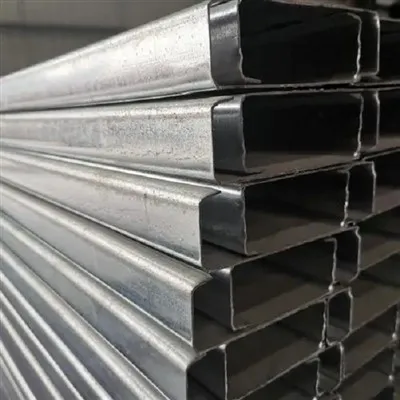
Hey there! As a supplier of seamless square tubes, I often get asked about the difference between hot-rolled and cold-drawn seamless square tubes. It's a topic that's crucial for anyone in the construction, manufacturing, or any industry that relies on these tubes. So, let's dive right in and break it down.
Manufacturing Process
First off, let's talk about how these tubes are made. Hot-rolled seamless square tubes are produced at extremely high temperatures. The process starts with a solid billet of steel. This billet is heated to a temperature where it becomes malleable, usually around 1,200°C. Once it's hot enough, it's pierced through the center with a mandrel to create a hollow tube. Then, it goes through a series of rolling mills to shape it into the desired square cross-section.
On the other hand, cold-drawn seamless square tubes start as hot-rolled tubes. After the initial hot-rolling process, the tubes are cold-drawn. This means they're pulled through a die at room temperature. This process refines the dimensions of the tube, making it more precise. The cold-drawing process also improves the surface finish of the tube, giving it a smoother look.
Dimensional Accuracy
When it comes to dimensional accuracy, cold-drawn seamless square tubes have the upper hand. The cold-drawing process allows for very tight tolerances. This means that the tubes have a more consistent size and shape. For applications where precision is key, like in the aerospace or automotive industries, cold-drawn tubes are often the preferred choice.
Hot-rolled seamless square tubes, on the other hand, have slightly looser tolerances. The high temperatures involved in the hot-rolling process can cause some minor variations in the dimensions of the tube. However, for many general construction and structural applications, these variations are acceptable.


Surface Finish
The surface finish is another area where these two types of tubes differ. Cold-drawn seamless square tubes have a smooth and shiny surface. The cold-drawing process removes any surface imperfections and gives the tube a clean, professional look. This makes them ideal for applications where appearance matters, such as in architectural structures or furniture.
Hot-rolled seamless square tubes, on the other hand, have a rougher surface. The high temperatures and the rolling process leave a scale on the surface of the tube. This scale needs to be removed if a smooth surface is required. However, in some applications, like in underground construction or where the tube will be coated, the rough surface may not be a problem.
Mechanical Properties
The mechanical properties of hot-rolled and cold-drawn seamless square tubes also vary. Hot-rolled tubes generally have better ductility. This means they can be bent and shaped more easily without cracking. They're also more forgiving when it comes to welding. The high temperatures during the hot-rolling process help to relieve internal stresses in the tube, making it more suitable for applications where the tube will be subjected to heavy loads or dynamic forces.
Cold-drawn tubes, on the other hand, have higher strength and hardness. The cold-drawing process work-hardens the steel, increasing its strength. This makes them ideal for applications where high strength is required, such as in the manufacturing of machinery or in high-rise buildings.
Cost
Cost is always a factor when choosing between hot-rolled and cold-drawn seamless square tubes. Hot-rolled tubes are generally less expensive. The manufacturing process is simpler and requires less energy, which translates to lower production costs. For large-scale construction projects where cost is a major concern, hot-rolled tubes are often the go-to option.
Cold-drawn tubes, on the other hand, are more expensive. The additional cold-drawing process adds to the production cost. However, for applications where precision, surface finish, or high strength is required, the extra cost may be worth it.
Applications
The choice between hot-rolled and cold-drawn seamless square tubes also depends on the application. Hot-rolled tubes are commonly used in general construction, such as in building frames, bridges, and pipelines. They're also used in the manufacturing of heavy machinery and equipment.
Cold-drawn tubes, on the other hand, are often used in applications where precision and high strength are required. They're commonly used in the automotive, aerospace, and electronics industries. They're also used in the manufacturing of precision instruments and tools.
If you're interested in learning more about seamless square tubes, you can check out our Rectangular Pipe Square Tubing, Rectangular Steel Tubing, and Galvanized Rectangular Tube pages.
In conclusion, both hot-rolled and cold-drawn seamless square tubes have their own unique advantages and disadvantages. The choice between the two depends on the specific requirements of your project. If you're still not sure which type of tube is right for you, don't hesitate to reach out. We're here to help you make the best decision for your needs. Whether you need a large quantity for a big construction project or a small batch for a specialized application, we've got you covered. So, if you're in the market for seamless square tubes, let's have a chat and see how we can work together.